
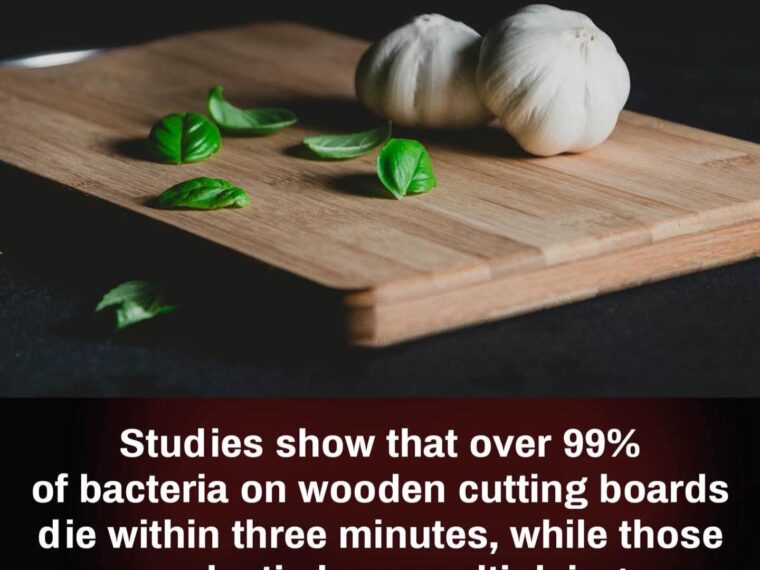
Why Wooden Cutting Boards Are Safer Than Plastic, According to Science 🧼🔪
What Happens to Bacteria After You Cut Food Might Surprise You
For years, plastic cutting boards were promoted as the “more hygienic” choice, while wooden boards were considered risky and old-fashioned. But scientific research has shown that this assumption is not only wrong—it’s often the opposite of the truth.
Studies conducted by researchers at the University of Wisconsin revealed a striking difference:
Over 99% of bacteria placed on wooden cutting boards died within minutes, while bacteria on plastic boards survived and multiplied inside knife-made grooves.
Understanding why this happens can change how you think about kitchen hygiene.
🧪 What the Research Found
Researchers compared wooden and plastic cutting boards after contaminating them with common foodborne bacteria.
The results were clear:
- On wooden cutting boards, most bacteria died within 3 minutes
- On plastic cutting boards, bacteria survived and multiplied
- Knife marks in plastic created micro-cracks that trapped moisture and bacteria
- Normal washing did not always remove bacteria from plastic grooves
Wood did not behave the same way.
🌳 Why Wood Kills Bacteria Naturally
Wood is not just a surface—it’s a living material, even after being cut into a board.
Here’s what makes wood different:
- Porous structure pulls bacteria down into the wood
- Once inside, bacteria dry out and die
- Wood fibers contain natural antimicrobial compounds
- Moisture is absorbed instead of sitting on the surface
Instead of allowing bacteria to spread, wood isolates and neutralizes them.
🧫 Why Plastic Boards Can Be Risky
Plastic boards may look smooth at first, but knives quickly change that.
The problem with plastic:
- Knife cuts create deep, invisible grooves
- Bacteria hide inside these cracks
- Moisture stays trapped
- Scrubbing often can’t reach deep enough
- Dishwashers don’t always solve the problem
Over time, plastic boards become bacterial shelters, not clean surfaces.
🧼 “But Plastic Can Go in the Dishwasher…”
While high heat can reduce bacteria, it doesn’t eliminate the structural problem.
Even after washing:
- Grooves remain
- New bacteria settle quickly
- Cross-contamination risk increases
Wooden boards, when properly dried, continue to resist bacterial survival naturally.
🪵 Best Woods for Cutting Boards
Not all wood is the same.
The safest choices:
- Maple
- Beech
- Walnut
- Bamboo (technically grass, but similar properties)
Avoid:
- Soft woods (pine, fir)
- Cracked or untreated boards
Hardwoods are dense enough to be durable while still antimicrobial.
🧽 How to Safely Care for a Wooden Cutting Board
Wood boards are safe when cared for correctly.
Proper care includes:
- Wash with hot water and mild soap
- Dry immediately—never leave soaking
- Oil occasionally with food-grade mineral oil
- Let boards air-dry upright
With good care, a wooden board can last decades.
🍗 What About Raw Meat?
This is the biggest concern for most people.
Research shows:
- Wood does not increase food poisoning risk
- Bacteria die faster on wood than plastic
- Proper cleaning matters more than material
Using separate boards for meat and vegetables is still best practice—regardless of material.
🧠 What This Teaches Us About Hygiene
Clean doesn’t always mean “non-porous.”
Sometimes nature designs better solutions than plastic ever could.
Wood:
- Works with physics and biology
- Reduces bacterial survival naturally
- Ages better than plastic
- Is more environmentally friendly
🌿 Final Thoughts
The idea that plastic cutting boards are safer is outdated.
Scientific studies show that wooden cutting boards actively reduce bacteria, while plastic boards can quietly harbor and spread it.
When properly maintained, wood isn’t just safe—it may be the safer choice.
Sometimes, the old ways really are better.