
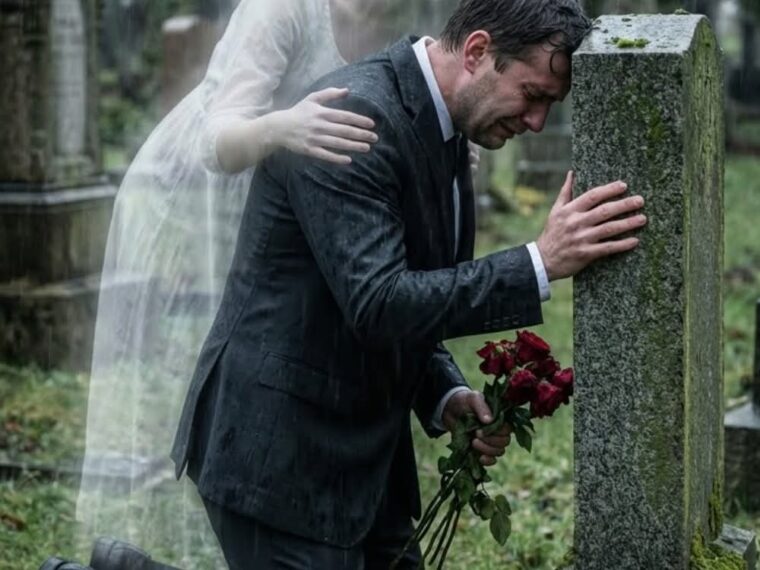
The day before my second wedding, I went somewhere I hadn’t planned to stay long.
I told myself it would be brief—just enough time to clear the weeds from the stone, replace the wilted flowers, and say a quiet goodbye. Nothing dramatic. Nothing emotional.
But grief never respects schedules.
My name is Daniel Whitmore. Four years ago, my first wife, Anna, was killed by a drunk driver on a rainy night not unlike this one. She was thirty-two. One moment she was laughing at something on the radio, and the next, she was gone. Since then, I’ve lived in Seattle, moving through days on autopilot, surviving rather than living, convincing myself that routine was the same thing as healing.
Then Claire entered my life.
She didn’t try to save me. She didn’t rush me. She simply stood where the emptiness was and didn’t turn away. She noticed the pauses in my sentences, the way I avoided certain memories. She asked questions that weren’t intrusive, just honest. Over time—slowly, quietly—I fell in love again.
And that terrified me.
As our wedding approached, the guilt grew heavier. Every detail felt like a betrayal. Was I dishonoring Anna by moving forward? Or was I being unfair to Claire by loving her with a heart that still ached for someone else?
That confusion is what brought me to the cemetery that night.
Rain soaked my jacket as I knelt beside Anna’s grave, brushing mud from the carved letters of her name. My hands shook—not from the cold, but from the truth pressing against my chest.
“I still love you,” I whispered. “And I love her too. I don’t know how to hold both without breaking.”
The rain answered for her.
Then, behind me, a voice spoke—soft, steady, unmistakably human.
“Love doesn’t disappear just because someone does.”
I turned, startled.
A woman stood a few steps away, holding a small bundle of white roses.
Rain clung to her hair and coat, yet she seemed oddly untouched by it. Her expression wasn’t curious or intrusive—just gentle.
“You don’t stop loving the dead,” she continued. “You just learn to carry that love in a different way.”
Her name was Elena Hayes. She told me her brother had died while serving overseas three years earlier. Stormy nights drew her here, she said. They felt honest. Unfiltered.
We talked—not as strangers, but as people who recognized the same fracture in each other. She didn’t offer advice. She didn’t try to fix me. She simply understood.
When she finally walked away, disappearing between the headstones, something inside me shifted. I wasn’t healed. But I felt… opened. As if the weight I’d been carrying had cracked instead of crushing me.
I left the cemetery soaked through, my body cold, my mind unsettled. Guilt and hope twisted together, inseparable.
The next morning, standing at the altar, I watched Claire walk toward me—her eyes steady, her smile nervous and real.
I knew then that love wasn’t a choice between past and present.
But Elena’s words echoed in my mind like a quiet warning, reminding me that some truths don’t demand answers—only honesty.
And that the way we carry love matters just as much as who we give it to.
And when the minister asked, “Do you, Daniel, take this woman—forsaking all others?” my throat closed.
My entire future hung on my answer.
And in that suspended second, something happened that no one in the chapel was prepared for…
It felt like the world had stopped. My palms were sweating, my heart pounding loud enough to drown out the murmurs behind me. Claire’s eyes searched mine—steady, patient, but fearful too. She deserved certainty. I had none.
The minister cleared his throat. “Daniel?”
My lips parted, but the words wouldn’t come.
Then a door at the back of the small chapel creaked open. Everyone turned.
A woman stepped inside—her clothes still damp from the storm, her hair pulled back in a messy bun. Elena. From the cemetery.
TO CONTINUE READING THE ARTICLE PLEASE SEE PAGE 2