
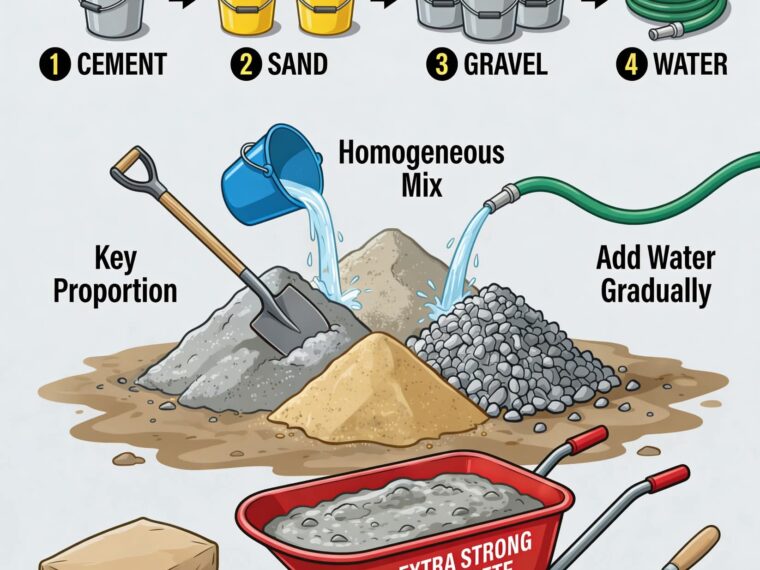
The Strongest Concrete Mix Ratio
Cement, Sand, Gravel & Water Explained Clearly
When people ask for the “strongest” concrete mix, what they usually mean is:
What ratio gives the highest strength without causing cracking or failure?
The answer depends on the project, but there are proven mix ratios used worldwide for high-strength concrete.
Let’s break it down properly.
Understanding Concrete Strength
Concrete strength depends mainly on:
- Cement content
- Aggregate quality (sand & gravel)
- Water-to-cement ratio
- Proper mixing and curing
The most critical factor?
👉 The water-to-cement ratio
Too much water weakens concrete dramatically.
Standard Strong Concrete Mix Ratio (General Construction)
For strong structural concrete (foundations, slabs, columns):
1 : 2 : 3 Ratio
- 1 part cement
- 2 parts sand
- 3 parts gravel
- Water: about 0.45–0.50 of cement weight
This mix typically produces concrete around 20–30 MPa (3000–4000 psi) when properly cured.
This is strong enough for:
- House foundations
- Slabs
- Driveways
- Structural columns
Higher Strength Concrete Mix
If you want even stronger concrete (heavy-duty slabs, load-bearing structures):
1 : 1.5 : 3 Ratio
- 1 part cement
- 1.5 parts sand
- 3 parts gravel
- Lower water ratio (very important)
This increases cement content, improving compressive strength.
Very High Strength (Professional Grade)
For projects requiring very high strength (above 40 MPa / 6000 psi):
- Increase cement content
- Reduce water further
- Use plasticizers (water-reducing admixtures)
- Use high-quality crushed aggregate
This level is usually mixed with engineered specifications.
The Most Important Rule: Water Control
The strongest concrete is not the one with the most cement —
it’s the one with the least water needed for workability.
Ideal water-to-cement ratio:
- 0.40 – 0.50
If concrete is too watery:
- It shrinks more
- It cracks
- It becomes weaker
If too dry:
- It won’t bond properly
The goal is a workable but stiff mix.
Example Mix for Small DIY Batch
For a small project:
- 1 bucket cement
- 2 buckets sand
- 3 buckets gravel
- Add water slowly until mixture holds shape but is not runny
Test:
Squeeze a handful (with gloves). It should hold shape without dripping water.
Quality of Materials Matters
Even the perfect ratio fails if:
- Sand contains clay
- Gravel is dirty
- Cement is old
- Water is contaminated
Always use:
- Clean, sharp sand
- Crushed stone or gravel
- Fresh cement
- Clean water
Proper Curing = Maximum Strength
Concrete continues gaining strength for 28 days.
To prevent cracking:
- Keep surface moist for at least 7 days
- Avoid rapid drying
- Cover with plastic or wet burlap
Poor curing can reduce strength by 30% or more.
Common Mistakes
❌ Adding extra water to make it easier to pour
❌ Using too much sand
❌ Skipping curing
❌ Mixing inconsistently
Final Recommendation
For most strong residential work, use:
👉 1 : 2 : 3 mix ratio
👉 Control water carefully
👉 Cure properly
That combination gives excellent strength, durability, and long-term performance.