
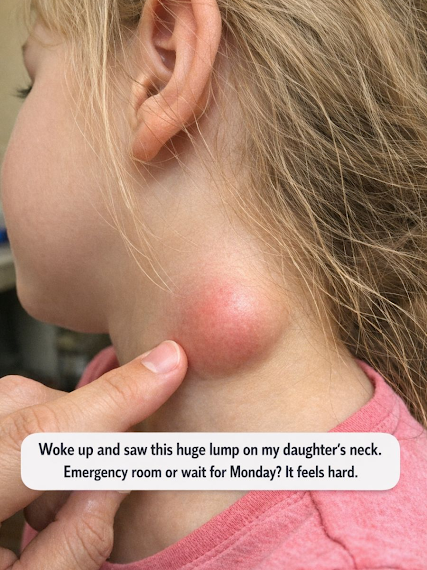
I Woke Up and Saw This Huge Lump on My Daughter’s Neck: Should I Go to the Emergency Room or Wait Until Monday?
Finding a large lump on your child’s neck can be frightening, especially when it appears suddenly and without a clear explanation. Many parents experience panic when they notice unusual swelling on their child’s body, and the immediate question that comes to mind is whether this situation requires emergency medical attention or if it can wait for a scheduled doctor visit.
If you woke up and discovered a hard lump on your daughter’s neck, it is important to stay calm while carefully assessing the situation. Not every neck lump is a medical emergency, but some symptoms require urgent evaluation.
Health professionals from the American Academy of Pediatrics recommend that parents observe accompanying symptoms and the physical characteristics of the swelling before deciding whether to go to the emergency room.
This article will help you understand what might be happening, how to evaluate the situation, and when immediate medical care is necessary.
First, Stay Calm and Observe the Lump
The first and most important step is to avoid panic.
Children can develop neck lumps for many different reasons, and many of them are not life-threatening. Swollen lymph nodes are one of the most common causes, especially if the child recently had a viral infection, sore throat, or minor illness.
Lymph nodes are part of the immune system and may become enlarged when the body is fighting infection. In children, lymph node swelling is actually quite common.
However, sudden appearance of a large, hard, or painful lump should always be taken seriously.
Begin by gently observing the lump without pressing too hard on it.
Check the following characteristics:
Size of the lump
Whether it feels soft, firm, or hard
Whether it moves slightly under the skin or feels fixed in place
Presence of redness or warmth around the area
Whether the child complains of pain
These observations can help guide your next decision.
Is It an Emergency?
You should consider going to the emergency room immediately if any of the following symptoms are present.
Difficulty Breathing or Swallowing
If the lump is pressing on airway structures, your child may show signs of breathing difficulty.
Watch for:
Fast or labored breathing
Wheezing or unusual breathing sounds
Trouble swallowing food or saliva
Panic or distress when trying to breathe
This is considered a medical emergency because airway obstruction can develop quickly.
Rapidly Growing Lump
A lump that increases in size within hours is concerning.
Rapid enlargement may indicate infection, bleeding inside the tissue, or other urgent medical conditions.
If you noticed the lump suddenly and it continues to grow, do not wait until Monday.
Seek emergency evaluation.
High Fever
If your daughter has a high fever together with the neck lump, especially fever above 39°C (102°F), it may suggest serious infection.
Infections involving deep neck tissues can become dangerous if untreated.
Fever combined with neck swelling should be assessed by medical professionals as soon as possible.
Severe Pain or Extreme Tenderness
If touching the lump causes severe pain or if your child refuses to move her neck because of discomfort, this may indicate infection or inflammation that requires treatment.
Some bacterial infections may progress quickly in children.
Doctors may need to perform blood tests or imaging studies to determine the cause.
Skin Redness or Heat Over the Lump
If the skin covering the lump appears red, warm, or swollen, this may suggest an active infection.
This symptom is particularly important if it is accompanied by fever.
When You May Wait and Schedule a Doctor Appointment
Not every neck lump requires an emergency room visit.
You may be able to wait and schedule a pediatrician appointment within a day or two if the following conditions are present:
The child is breathing normally
There is no swallowing difficulty
The lump is not rapidly growing
Pain is mild or absent
The child is alert and active
There is no high fever
However, even in non-emergency situations, a medical evaluation is still important.
Common Causes of Neck Lumps in Children
Understanding possible causes can help reduce anxiety.
Swollen Lymph Nodes
This is the most common cause of neck lumps in children.
Lymph nodes may enlarge due to:
Common cold
Throat infection
Ear infection
Viral illness
Dental problems
These lumps are often movable and may feel slightly tender.
Many cases resolve naturally after the underlying infection improves.
Bacterial Infection
Bacterial infections can cause painful swelling that may require antibiotics.
Unlike viral-related swelling, bacterial infections may present with stronger pain, fever, and redness.
Medical treatment is usually necessary.
Congenital Cysts
Some children are born with small cysts that may become noticeable later.
These cysts are usually not dangerous but may require surgical removal if they grow or become infected.
Inflammatory Conditions
Autoimmune or inflammatory disorders can sometimes cause lymph node enlargement.
Although less common, these conditions should be ruled out if swelling persists.
Tumors (Rare but Important to Consider)
Parents naturally worry about cancer when they find a lump on their child’s neck.
While tumors are relatively rare in children, persistent, hard, painless lumps that do not shrink over time should be medically evaluated.
Early diagnosis is essential if any serious condition is suspected.
What You Should NOT Do
Avoid the following actions until a doctor evaluates the lump.
Do not press or squeeze the lump repeatedly.
Do not attempt home drainage or apply unverified treatments.
Do not give antibiotics without medical prescription.
Do not ignore symptoms if they worsen.
Improper handling can aggravate infection or delay proper diagnosis.
How Doctors May Evaluate the Lump
If you take your daughter to a medical clinic or emergency department, doctors may perform several assessments.
They may:
Examine the lump’s size, texture, and mobility
Check throat, ears, and mouth for infection sources
Order blood tests to look for infection markers
Recommend ultrasound imaging if needed
Imaging tests help distinguish between fluid-filled cysts, lymph node enlargement, or other structural causes.
When Monitoring at Home Is Acceptable
If a doctor determines that the lump is likely benign, they may recommend observation.
During monitoring, watch for:
Changes in size
Development of fever
Pain progression
Skin color changes
New symptoms appearing
If anything worsens, return for medical review.
Emotional Stress for Parents
It is completely normal to feel frightened when discovering a sudden lump on your child’s body.
Parents often imagine worst-case scenarios, but many childhood neck swellings are treatable and temporary.
Try to stay rational while assessing symptoms.
If possible, gently ask your daughter how she feels and whether the lump hurts.
Children sometimes hide discomfort, so careful communication is important.
The Importance of Early Medical Consultation
Even if the situation is not an emergency, it is generally safer to have a pediatric professional evaluate the lump rather than waiting too long.
Early diagnosis provides peace of mind and ensures that if treatment is needed, it can be started promptly.
The guidance from pediatric health organizations emphasizes that unexplained neck swelling in children should not be ignored for extended periods.
Final Decision Guide
Go to the emergency room immediately if:
Your daughter has breathing or swallowing difficulty
The lump is rapidly enlarging
High fever is present
Severe pain occurs
The child appears very weak or distressed
You may schedule a doctor visit within 24–48 hours if:
The child is stable and breathing normally
There is no high fever
The lump is not growing quickly
Final Thoughts
Discovering a large lump on your daughter’s neck can be terrifying, but not every swelling represents a medical emergency.
The key is careful observation and understanding warning signs that require urgent care.
Trust your instincts as a parent. If something feels seriously wrong, it is always acceptable to visit the emergency room for reassurance.
Your child’s safety and health should always come first.