
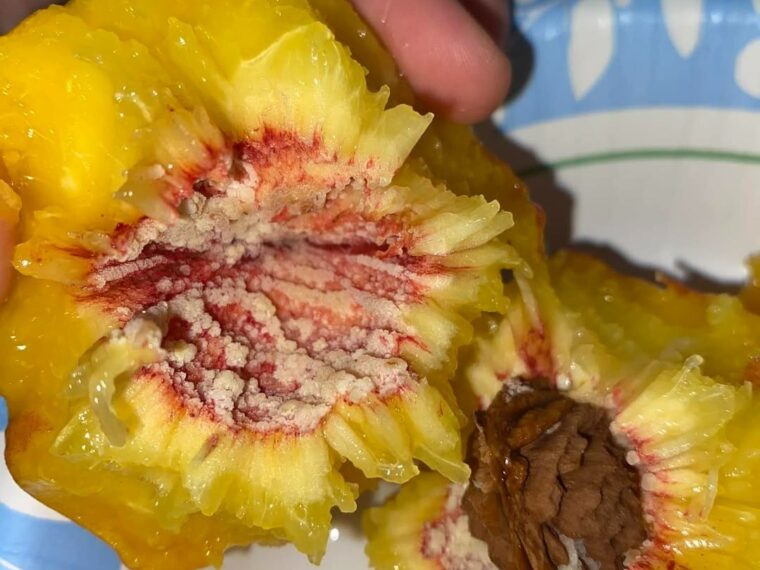
You’re enjoying a perfectly ripe, juicy peach—the kind that tastes like pure summer. As you twist the fruit open and remove the pit, you notice something unusual: a fuzzy, white, cotton-like substance clinging to the stone.
Your first thought?
Is it mold?
Is the peach spoiled?
Is it safe to eat?
Take a deep breath.
That white substance is not mold, rot, or contamination.
It’s something completely natural called peach callus tissue, and it’s perfectly harmless.
In fact, its presence often means you’re eating a fresh, tree-ripened peach.
Let’s take a closer look at what it is, why it appears, and when (rarely) you should be concerned.
What Is Peach Callus Tissue? (Science, Made Simple)
Peach callus tissue is a cluster of undifferentiated plant cells that forms naturally on the surface of the pit (the endocarp) as the fruit develops.
You can think of these cells as the peach’s version of stem cells—they haven’t specialized yet. In nature, if the pit falls to the ground and begins to sprout, this tissue can help initiate early root development.
In your kitchen, though, it’s simply a harmless byproduct of the peach’s natural growth. It has no taste, no smell, and no negative effect on the fruit.
Fun fact: Horticulturists actually use callus tissue in laboratories to propagate new peach trees through tissue culture.
Why Do Some Peach Pits Have It—and Others Don’t?
Not all peaches show callus tissue, and that’s completely normal. Its appearance depends on several factors:
Peach variety: Certain cultivars (like Red Haven or Elberta) develop it more often
Ripeness: Fully tree-ripened peaches are more likely to show it than fruit picked early
Growing conditions: Warm days, cool nights, and good hydration encourage healthy cell growth
Genetics: Just like freckles in people, some peaches naturally develop it and others don’t
Good news: It’s more common in organic or locally grown peaches, where fruit is allowed to mature naturally.
Callus Tissue vs. Mold: How to Tell the Difference
While mold can grow on peaches, it looks very different from callus tissue.
FEATURE CALLUS TISSUE MOLD
Color Bright white or slightly creamy Green, gray, black, or blue
Texture Smooth, cottony, firmly attached to the pit Powdery or fuzzy, spreads easily
Smell No odor; fruit smells fresh Sour, musty, or fermented
Location Only on the pit On skin or flesh, often near bruises
Important: If mold appears on the peach flesh, discard the entire fruit. Callus tissue stays on the pit and does not spread.
Is It Safe to Eat?
Yes. Peach callus tissue is non-toxic and completely safe.
You don’t need to remove it
Simply eat the peach as usual, avoiding the pit
Never eat the pit itself—it contains amygdalin, which can release cyanide if crushed
Pro tip: If you’re making jam, canning, or freezing peaches and the tissue bothers you, just rinse the pit—it washes off easily.
Can You Grow a Peach Tree from a Pit with Callus Tissue?
Many gardeners see callus tissue as a sign of a viable seed—and they’re not wrong.
While callus tissue alone doesn’t guarantee sprouting, it can indicate a healthy pit. If you want to try growing a tree:
Clean and dry the pit
Cold-stratify it in the refrigerator for 8–12 weeks
Plant it in potting soil and be patient
Keep in mind: Most store-bought peaches are hybrids, so the tree may not produce identical fruit—but it can still grow into a beautiful ornamental tree.
Final Thought: A Natural Quirk, Not a Flaw
That white fluff isn’t a defect—it’s a quiet reminder that fruit is a living thing.
In a world obsessed with perfect, uniform produce, peach callus tissue is a small sign of natural growth and biological complexity.
So next time you see it, don’t worry.
You’re not eating a spoiled peach.
You’re witnessing nature doing exactly what it’s meant to do.
The best peaches aren’t perfect—they’re alive.
Disclaimer: While peach callus tissue is harmless, always discard fruit with mold on the flesh, a foul odor, or extreme softness. Peach pits should never be eaten due to cyanide-producing compounds.


