
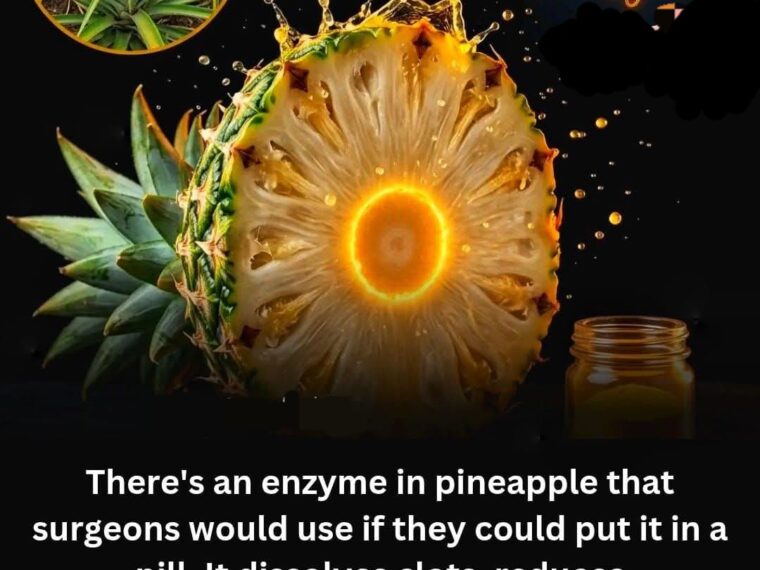
Pineapple is known for being tangy, tropical, and delicious. What almost no one knows is that it contains one of the most powerful enzymes in the plant kingdom.
It’s called bromelain. And it’s not in the sweet part you eat; it’s concentrated mainly in the core and the core of the pineapple (that hard, central part that most people throw away).
What is an enzyme, and why does it matter?
Imagine an enzyme as a tiny molecular machine with a very specific task. Bromelain’s task is to break down proteins—and it does so with extraordinary efficiency. That sounds simple, but the implications for the body are enormous.
The 5 powers of bromelain that science has confirmed:
The first is that it digests and reduces inflammation at the same time. When there is inflammation in the body after an injury, surgery, or in a sore joint, inflammatory proteins accumulate in the tissue. Bromelain literally breaks them down. That’s why it’s used in integrative medicine as a natural anti-inflammatory for arthritis, sports injuries, sinusitis, and post-surgery recovery. A review published on PubMed in December 2025 (PMID:41385123) confirmed its potent anti-inflammatory, antioxidant, and cardioprotective activity.
The second benefit is that it reduces pain comparable to ibuprofen. A clinical trial published in PMC/NIH (2024) evaluated bromelain in patients after wisdom tooth extraction, one of the most intense post-surgical pains. Bromelain at 800 mg/day for 3 days, then 400 mg/day for 4 days, showed significant analgesic and anti-inflammatory effects and reduced the need for ibuprofen. The same results were achieved with fewer digestive side effects.
The third benefit is that it dissolves clots and improves circulation. Bromelain has fibrinolytic activity, breaking down fibrin, the protein that forms clots. This makes it an ally in preventing thrombosis and improving blood flow. Therefore, caution should be exercised if taking anticoagulants, as the interaction can be significant.
The fourth benefit is that it improves the absorption of other nutrients and medications. This is a little-known but fascinating property. Bromelain selectively improves intestinal permeability—facilitating the passage of other compounds through the intestinal wall. This is why it is being used in pharmaceutical research to enhance the bioavailability of antibiotics and chemotherapeutic agents.
The fifth benefit is that it supports the immune system. It activates and improves the response of T lymphocytes, the body’s defense cells. A study on bromelain in inflammatory bowel diseases found that it significantly reduces inflammatory activity and the secretion of pro-inflammatory cytokines.
PROTOCOL FOR PINEAPPLE AND BROMELAIN:
The simplest way, and the one most people don’t take advantage of:
Eat the core. That hard, fibrous part in the center of the pineapple that everyone discards has the highest concentration of bromelain of the entire fruit. The next time you cut a pineapple, instead of throwing away the core, cut it into small pieces and eat it or add it to a smoothie. It’s the simplest and most underutilized decision in all of practical nutrition.
To take advantage of its digestive benefits:
Eat fresh pineapple or drink natural pineapple juice 20-30 minutes before meals rich in meat, legumes, or eggs. The protein bromelain begins working in the stomach, predigesting proteins before they reach the small intestine. This reduces post-meal bloating, gas, and that heavy feeling! Canned or cooked pineapple does NOT contain active bromelain; heat destroys it. Only fresh pineapple or freshly squeezed natural juice contains it.
For inflammation and pain – bromelain supplement:
Bromelain as a supplement is taken between meals (not with food; with food it works on digestion; between meals it reaches the bloodstream and acts on systemic inflammation). Typical dose: 500-1000 mg between meals, twice a day. Look for supplements standardized in GDU (Gelatin Digesting Units), minimum 1000 GDU/g.
For post-operative or after sports injuries:
Bromelain at 500-1000 mg/day between meals for the first 1-2 weeks post-injury reduces edema (swelling) and accelerates tissue recovery. This is the most clinically documented use and the one most frequently prescribed by integrative surgeons.
Caution: Do not use if you are taking anticoagulants (warfarin, heparin) or antiplatelet drugs (aspirin at antiplatelet doses) without consulting a doctor. Bromelain enhances the effect and may increase the risk of bleeding. People with pineapple allergies should obviously avoid it.
Sources verificadas 📚: PMID:41385123
Bromelain therapeutic potential & nanoformulations (Daru, Dec 2025). PMC: 11243481 Therapeutic potential of bromelain (2024). PMC:10974198 Pineapple extract vs ibuprofen post-surgery RCT (2024). Nature: s41598 Bromelain in IBD (Nov 2025).