
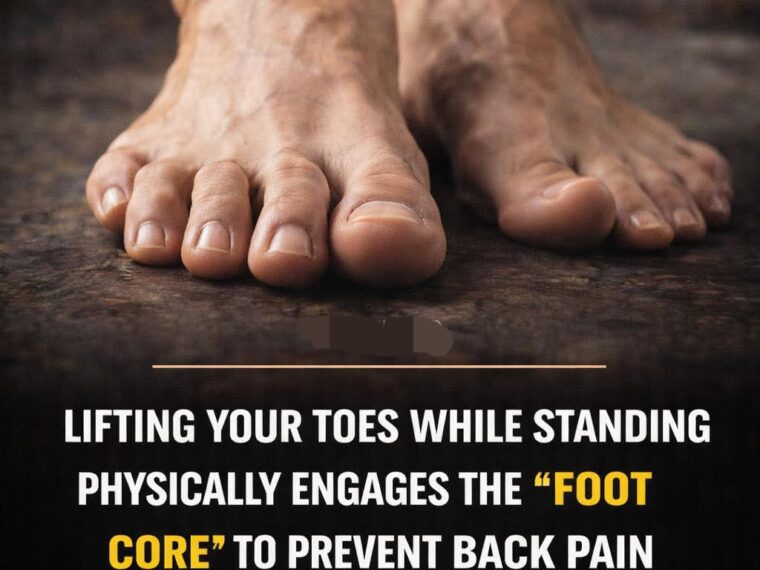
The Hidden Core of Your Feet: Why the “Short Foot” Exercise Changes Everything
When people think about core strength, they usually imagine the abdominals or the muscles surrounding the spine. But just as the spine has a core that stabilizes the body, the feet have their own “intrinsic muscle core.”
These small, powerful muscles form the foundation of your entire kinetic chain — the interconnected system linking your feet, ankles, knees, hips, and spine. When the foundation is weak, everything above it must compensate.
One simple movement — often called the “Short Foot” exercise — can help restore that foundation.
What Is the Foot’s Intrinsic Muscle Core?
Your feet contain intrinsic muscles, meaning they originate and insert within the foot itself. Unlike larger muscles that move the ankle or toes from outside the foot, intrinsic muscles provide fine control and stability.
Key functions include:
- Supporting the arch
- Stabilizing the toes during walking and running
- Assisting balance
- Absorbing and distributing force
One of the most important of these muscles is the abductor hallucis, which runs along the inside of the foot and plays a crucial role in arch support.
When these muscles weaken — often due to supportive shoes, flat surfaces, or lack of barefoot activity — the arch can collapse, leading to instability that travels upward through the body.
Why Foot Stability Affects the Entire Body
The body works as a chain. If one link becomes unstable, other areas compensate.
Weak intrinsic foot muscles can contribute to:
- Overpronation (arch collapse)
- Ankle misalignment
- Knee valgus (knees collapsing inward)
- Hip instability
- Lower back strain
When the arch flattens, the ankle rotates inward. This changes knee tracking, alters hip positioning, and increases compensatory stress on the lower back.
In short: unstable feet can mean an overworked spine.
The “Short Foot” Exercise Explained
The Short Foot exercise is deceptively simple — but highly effective.
How to Perform It
- Stand barefoot with feet hip-width apart.
- Keep the heel and the ball of the foot grounded.
- Without curling your toes, gently draw the ball of your foot toward your heel.
- This creates a subtle lift in the arch.
- Hold for 5–10 seconds while breathing normally.
- Relax and repeat 8–10 times per foot.
It may look like nothing is happening, but internally, you are activating the intrinsic foot muscles — especially the abductor hallucis.
Important:
Do not grip the floor with your toes. The movement should be controlled and subtle, not forceful.
What Happens Biomechanically
When you activate the intrinsic foot muscles:
- The arch lifts naturally
- The ankle aligns more neutrally
- The tibia (shin bone) rotates into better alignment
- The knee tracks more efficiently
- The hips stabilize
- Lower back strain decreases
This mechanical engagement improves proprioception (body awareness) and creates a more stable base for movement.
Over time, this can improve:
- Balance
- Postural control
- Walking mechanics
- Athletic performance
- Load distribution during exercise
Who Benefits Most?
The Short Foot exercise is especially beneficial for:
- People with flat feet
- Individuals with plantar fasciitis
- Runners
- Those with recurring knee pain
- Anyone experiencing unexplained lower back tension
- People who stand for long hours
It’s also powerful for older adults working to maintain balance and prevent falls.
How to Integrate It Into Daily Life
You can practice the Short Foot exercise:
- While brushing your teeth
- During strength training
- Before running or walking
- As part of physical therapy routines
- While standing in line
For progression, try performing it:
- On one foot
- During squats
- While walking slowly
- On uneven surfaces
The goal is not just isolated activation — but integration into real movement.
The Bigger Picture: Strong Feet, Strong Foundation
Modern footwear and flat indoor environments have reduced the demand placed on our foot muscles. As a result, many people have underdeveloped intrinsic muscles and poor arch control.
Rebuilding foot strength restores the body’s natural shock absorption system.
When the feet are strong:
- Movement becomes more efficient
- Joint stress decreases
- Posture improves naturally
- The spine doesn’t have to compensate
It all starts at the ground.
Final Thoughts
Your feet are not just passive structures that carry you from place to place. They are dynamic stabilizers — a true muscular core at the base of your body.
The Short Foot exercise may look small, but its impact can be profound. By strengthening the intrinsic muscles and reactivating the arch-support system, you improve alignment from the ground up.
Sometimes, better posture and less back pain don’t start with the spine — they start with your feet.