
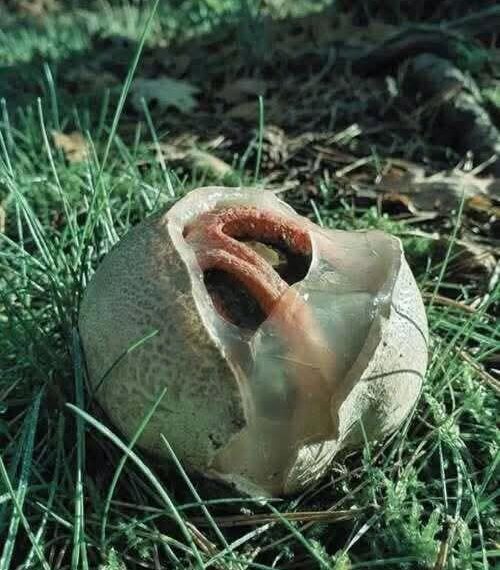
If you have ever walked through a forest after the rain and suddenly spotted something that looked like an alien egg cracking open on the ground, there is a good chance you encountered a stinkhorn mushroom. Known scientifically as Phallus impudicus and commonly referred to as the “stinkhorn,” this bizarre fungus has earned a reputation as one of the most frightening-looking organisms in the natural world. But what exactly is it, and why does it evoke such strong reactions from anyone who sees or smells it?
A Strange Life That Begins as an Egg

The life of a stinkhorn mushroom starts with a stage that confuses even experienced foragers: the “witch’s egg.” This rounded, rubbery structure sits partially buried in soil or grass, resembling a mysterious biological pod. When sliced open, it reveals a gelatinous interior and a folded structure that will later become the mushroom’s mature form. Many people describe this stage as looking like an alien embryo or a scene from a sci-fi movie, and it’s easy to understand why.
Within just a few hours—sometimes overnight—the egg splits open dramatically. From inside, the mushroom’s tall, sponge-like stalk emerges, growing at a surprisingly fast speed. Some stinkhorns can shoot up several inches in a single morning, making them one of the fastest-growing fungi on the planet.
The Infamous Smell: Why It Stinks Like Rotting Flesh
The shock of seeing a stinkhorn is nothing compared to the moment you smell one. As soon as the mushroom reaches maturity, it releases a foul odor that many describe as a mix of rotting meat, sewage, and decomposing animals. This unpleasant scent is not an accident—it’s a survival strategy.
Unlike many mushroom species that rely on wind to spread their spores, stinkhorns use insects. The slimy, dark cap at the top of the mushroom is coated with a substance called gleba, which contains both spores and the unmistakable smell. Flies, beetles, and other scavenging insects are attracted to the scent, land on the cap, and unintentionally carry the spores with them as they fly away. In other words, the stinkhorn’s revolting odor is actually a sophisticated biological method of reproduction.
A Terrifying Appearance With Useful Ecological Roles
Despite their disturbing look and strong smell, stinkhorn mushrooms play an important part in forest ecosystems. They are saprophytic fungi, meaning they help break down decaying wood, leaves, and organic matter. By doing so, they contribute to soil health and nutrient recycling.
Even so, their appearance continues to shock people. The tall, phallic shape of many stinkhorn species, combined with the dripping slime and the sudden way they burst out of their eggs, has earned them nicknames such as “devil’s egg,” “corpse fungus,” and “zombie mushroom.” These dramatic visuals have made stinkhorns go viral on social media whenever someone discovers one in their backyard.
Should You Be Afraid of Them?
Despite their frightening nickname, stinkhorn mushrooms are not dangerous to humans. Touching them is safe, and they are not poisonous, although their odor makes them extremely unappealing. Some cultures even eat the egg stage, though this is not recommended due to the risk of misidentifying them with toxic species.
A Natural Wonder That Challenges Our Comfort Zone
So why is the stinkhorn called “the most terrifying fungus in nature”? Because it combines everything that feels unsettling—unexpected movement, strange shapes, slimy textures, and a smell straight out of a horror movie. But beneath the shock value lies a remarkable organism that reflects the creativity and complexity of nature.
I Found A Frozen Dog Tied To A Bench With A Note That Made The Whole World Cry
Part 1: The Last Note

“Please love him. My owner is dead. If they find him, they will kill him.” She dropped the pill bottle into the snow, her heart stopping.
Margaret stared at the orange prescription bottle half-buried in the drift.
It was supposed to be the end.
At 65, she had nothing left.
Her husband was gone.
The bank had sent the final foreclosure notice on Friday.
The heat in her house had been cut off yesterday.
She had walked to the furthest, darkest corner of the park during the worst blizzard of the decade for one reason.
To go to sleep and never wake up.
But then she heard it.
A low, pathetic whimper.
It wasn’t human. It was too soft, too broken.
Margaret wiped the freezing tears from her cheeks and squinted into the gloom.
Ten feet away, tied to the leg of a metal bench with a thick, rough rope, was a lump of golden fur.
The dog was covered in a layer of fresh snow. He wasn’t moving, except for the violent shivering that shook his entire frame.
He looked exactly how Margaret felt.
Discarded. Unwanted. Invisible.
She forgot about the pills. She forgot about the numbness in her toes.
She crawled on her hands and knees through the ice toward the bench.
The dog lifted his head.
His eyes were wide, terrified, and filled with a sorrow so deep it knocked the wind out of her.
He didn’t growl. He didn’t bark. He just pressed his head against the cold metal leg of the bench, waiting for the end.
“Oh, you poor thing,” Margaret whispered, her voice cracking.
She reached out a trembling hand.
Under his collar, she felt something crinkle.
It was a plastic sandwich bag, taped shut to keep out the wet. Inside was a piece of notebook paper.
Margaret’s fingers were stiff with cold, but she managed to rip the bag open.
She held the note up to the dim light of the distant streetlamp.
The handwriting was shaky. Frantic.
“His name is Barnaby. Please take him. My owner died today. The people coming for the house… they hate him. They said they’ll put him down tomorrow to save money. I’m just the gardener, I can’t keep him. Run. Please.”
Margaret read it twice.
To save money.
Just like the bank taking her home. Just like the insurance company denying her husband’s treatment.
A life, measured in dollars and cents.
She looked at Barnaby.
He licked her hand. The tongue was warm, a stark contrast to the freezing night.
For the first time in two years, Margaret felt a spark of anger. A hot, burning rage in her chest.
They wanted to erase him. Just like the world wanted to erase her.
“Not tonight,” she whispered. “Not tonight, Barnaby.”
She began to fumble with the knot. It was tied tight, a complex knot she didn’t recognize.
Her arthritic fingers struggled.
Snap.
A twig broke in the woods behind her.
Margaret froze.
Then, a beam of light cut through the falling snow.
It swept across the trees, searching.
“I saw tracks over here!” a man’s voice shouted. deep and aggressive. “Big paw prints. And… boot prints?”
“Find him,” another voice growled. It sounded closer. Much closer. “The boss wants that dog gone tonight. No loose ends.”
Margaret’s heart hammered against her ribs.
These weren’t animal control officers. Animal control didn’t hunt in a blizzard at midnight.
Barnaby let out a small whine.
“Shh!” Margaret covered his muzzle gently.
The flashlight beam swung closer. It hit the tree right next to them.
She didn’t have time to untie the knot.
She reached into her pocket. She didn’t have a knife.
She had her house keys.
With adrenaline surging through her veins, she jammed the jagged edge of her key into the fibers of the rope.
“Over there! By the bench!”
The light hit them.
Margaret didn’t look up. She sawed frantically at the rope.
“Hey! You there!” the voice boomed. Heavy boots crunched on the snow, running toward them.
The rope frayed. One strand. Two strands.
“Get the dog!”
Snap.
The rope gave way.
Margaret grabbed Barnaby’s collar.
“Run!” she screamed.
She didn’t know where the energy came from. She scrambled up, her old joints popping, and pulled.
Barnaby didn’t hesitate. He seemed to understand.
Together, the old woman and the unwanted dog plunged into the darkness of the tree line, leaving the pill bottle buried in the snow behind them.
They were running for their lives. And for the first time in a long time, Margaret wasn’t running toward death.
She was running away from it.
But the footsteps behind them were getting faster.
Part 2: The Unwanted Guest
The heavy deadbolt slammed shut, but the terror outside didn’t stop. It just waited.
Margaret pressed her back against the door, her chest heaving.
Her lungs felt like they were filled with broken glass.
Beside her, the golden dog paced the small, dark hallway.
Click. Click. Click.
His nails on the hardwood floor sounded like ticking clocks in the silence of the house.
He wasn’t the calm, sad creature from the bench anymore.
Adrenaline had taken over.
He let out a low, mournful howl that echoed through the empty rooms.
Bang! Bang! Bang!
The wall shared with the next townhouse shook.
“Shut that animal up, Margaret!” a voice screeched from the other side.
It was Mrs. Gable. She had been waiting for a reason to complain for ten years.
“I’m calling the police if I hear one more sound!” Mrs. Gable yelled through the drywall. “You aren’t even supposed to be there! The bank owns that place now!”
Margaret froze.
Police.
If the police came, they would see the dog.
They would see the rope burns on his neck.
They would take him back to the men in the woods.
“Shh,” Margaret whispered, dropping to her knees. “Please, Barnaby. Please.”
She used the name from the note.
The dog stopped pacing. He looked at her.
His eyes were wide, the whites showing in the darkness.
Margaret reached out. She didn’t have food. She didn’t have dog toys.
She had an old, moth-eaten blanket on the sofa.
She pulled it down and wrapped it around his shivering shoulders.
“You’re safe,” she lied. “We’re safe.”
The dog collapsed into the blanket, his energy suddenly gone. He was just a puppy at heart, terrified and exhausted.
Margaret didn’t sleep.
She sat on the floor, her hand buried in his fur.
As the adrenaline faded, the cold of the unheated house crept in.
She could see her breath in the air.
She ran her fingers along his ribs. He was too thin.
Then, she felt it.
Ridges. Hard, lumpy lines under his skin.
She turned on the flashlight of her phone.
Old scars.
Dozens of them.
Some looked like cigarette burns. Others looked like he had been whipped with something thin, like a wire.
Tears welled in Margaret’s eyes.
“Who did this to you?” she whispered.
Barnaby let out a heavy sigh and rested his chin on her knee.
She scratched behind his ears, trying to offer comfort.
Her finger brushed against something hard inside the collar.
It wasn’t a tag.
It was a lump, sewn clumsily into the nylon fabric.
Curiosity piqued, Margaret used her fingernail to pick at the stitching.
A small, black square fell into her palm.
A memory card.
It was tiny—the kind that went into a phone or a camera.
Why would a gardener hide a memory card in a dog’s collar?
Before she could think, the morning sun began to bleed through the curtains.
The terror of the night was replaced by the dread of the day.
Knock. Knock. Knock.
Firm. Professional.
Margaret’s heart stopped.
She peeked through the peephole.
It wasn’t the police.
It was a man in a cheap suit. He held a clipboard.
“Mrs. Sullivan?” he called out. “This is the final notice from the asset management firm. You have 24 hours to vacate the premises.”
Margaret didn’t answer. She held her breath.
Barnaby let out a low ‘woof’.
“Shh!”
The man sighed, taped a bright orange paper to her door, and walked away.
Margaret slumped against the wall.
24 hours.
She had saved a dog, but she couldn’t save herself.
She crawled to the window to watch the man drive away.
But her eyes caught something else.
Across the street, parked under the large oak tree, was a black sedan.
The windows were tinted. The engine was idling.
It hadn’t moved since she woke up.
As she watched, the window rolled down just an inch.
Cigarette smoke drifted out.
Someone was watching the house.
They knew.
Margaret looked at the memory card in her hand, then at the orange notice on her door, and finally at the scarred dog sleeping on her floor.
She was trapped.
Part 3: The League of the Lonely
Margaret needed a weapon. She grabbed her late husband’s heavy brass candlestick.
TO CONTINUE READING THE ARTICLE PLEASE SEE PAGE 2


