
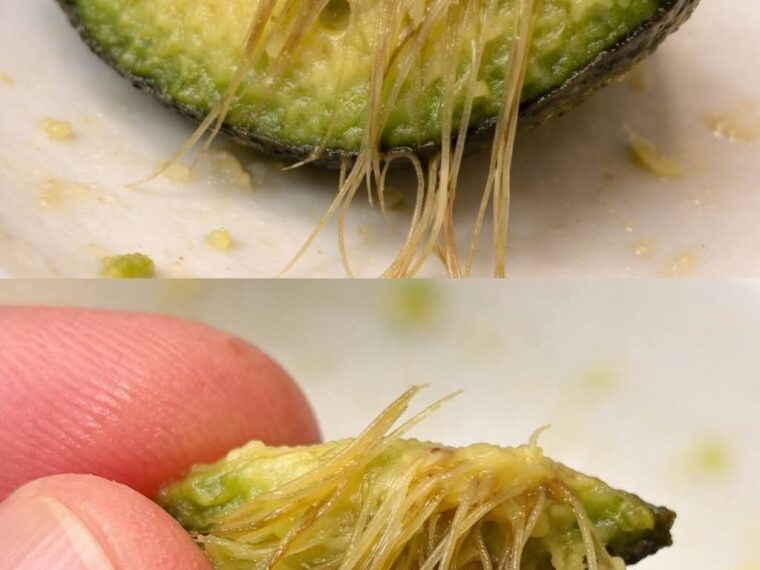
Fibers do not magically materialize, but when the majority of the flesh is extremely soft, the fibers become more noticeable. I’ve seen this particularly when an avocado has been left sitting on the counter for longer than anticipated.
Therefore, over-ripening does not create the fibers, but it certainly makes them more visible.
avocado cut in half
Are Stringy Avocados Safe to Consume?
One of the first questions I asked myself was: “are stringy avocados safe to eat?” Fortunately, the answer is, “yes”, in most cases.
Fibers are merely plant tissue, and therefore do not represent any health risks. The primary concern with a stringy avocado is the texture. A stringy avocado will not provide you with the silky smooth guacamole that you were anticipating. However, it is still edible.
However, I do throw away avocados from time to time. If it smells sour, has a fermented taste, or contains large areas of dark brown or black spots in the flesh, it is typically because the fruit has gone bad.
Signs of mold are also indicative that the fruit should not be consumed. However, if the only issue is the presence of visible strands, the avocado is usually still safe to eat.
Can You Buy Avocados That Won’t Be Stringy?
After experiencing multiple stringy avocados, I became more vigilant when purchasing avocados. Although you cannot ensure that you will never purchase a stringy avocado again, developing certain shopping habits will increase your odds.
smashing an avocado
I attempt to purchase avocados that are firm to the touch, but still yielding to pressure. Fruits that are far too soft are usually overripe, which will make the fibers more noticeable.
Additionally, I avoid avocados that seem excessively light compared to their size or look shriveled. From my own experience, these avocados have additional texture issues.
Shopping for avocados from a store with high turnover of produce seems to help. Produce shipped to stores with higher turnover is more likely to include fruit that has been harvested at the optimal time.
Despite the best efforts to shop carefully, it is possible for avocados to have texture issues regardless of where you shop. Fresh produce inherently includes a degree of variability.
How to Use a Stringy Avocado
Generally, I do not discard a stringy avocado. Instead, I determine alternative uses for the avocado.
Pureeing or thoroughly mashing the fruit will typically break down the fibers to the point that they are difficult to distinguish. Guacamole, smoothies, creamy salad dressing, and mashed avocado for toast are examples of acceptable uses.
Based on my personal experiences, once the avocado is pureed or mashed, the texture issue virtually disappears.
A stringy avocado is usually the result of the natural fibrous tissues of the avocado becoming more noticeable due to environmental stressors or harvest timing. Variation in the type of avocado or level of ripeness can also play a role. While the texture may not be as creamy as desired, the fruit itself is usually safe to eat. I have determined that these fibers are a natural aspect of how avocados are developed. If the texture is not ideal, using the avocado in a recipe that requires blending or mashing is a simple method to still utilize the fruit.