
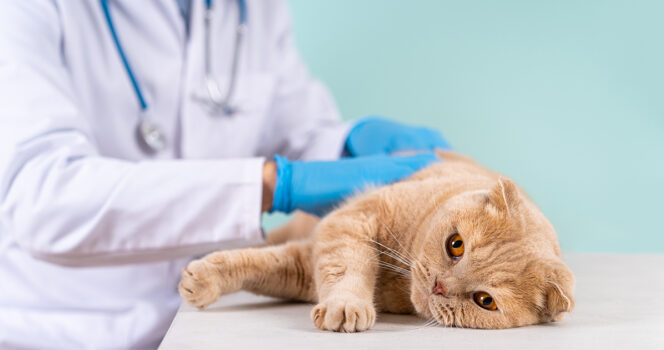
Cats are more than just pets – they are our companions and part of the family. They fill our homes with love, charm and warmth. But even though we wish they could live forever, the heartbreaking day comes when we must prepare to say our goodbyes.
Watching a beloved cat grow old or sick is one of the most difficult things a pet owner can experience. Cats are masters at hiding their pain, so it can be hard to detect when they are beginning to approach the end of their lives.
If you recognize the signs that your cat is not doing well, you can give it the care and love it deserves in its final days. In this guide, we’ll go over both the obvious and more unexpected signs that a cat is nearing the end of its life – and what you can do to give it the most peaceful farewell possible.
1. Hide-and-seek
Cats have always been known for their independence, and this applies even when they are not feeling well. As natural predators – but also prey – cats have instinctive behaviors that stem from their wild state. When a cat becomes sick or dying, it will often retreat and seek out secluded places. This is a defense mechanism to protect itself from potential predators and dangers.
Even domesticated house cats still have this instinct. Many cat owners find that their cat suddenly becomes more withdrawn or hides under furniture, in cupboards or in other hidden places when it is not feeling well. This can be a natural response to pain or weakness, but it can also be a sign that it is nearing the end of its life.
2. Reduced appetite and thirst
One of the clearest indications that a cat is nearing the end of its life is a noticeable decrease in appetite and thirst. Dying cats will often stop eating and drinking completely.

This can be a painful experience for owners to witness, but it is a natural part of the body’s way of preparing for the final stage of life.
3. More resting and sleeping
Your cat’s personality may begin to change. Some cats will change their activity level and may become weaker and less active.
A sign may also be that they spend more time resting or sleeping.
4. Breathing patterns change
When a cat is seriously ill or nearing the end of its life, its breathing may be noticeably altered.
Some cats start to breathe more shallowly, while others may develop a more irregular breathing rhythm. This is often due to the body weakening and organs starting to function more slowly.
5. Losing interest in their surroundings
The cat may become apathetic and less interested in the surroundings and people around it.
An otherwise social and playful cat may begin to withdraw, show less response to familiar voices or touch, and generally seem distant.
6. Coat becomes dull and woolly
A clear sign may be changes in the condition of the coat. The coat, which was previously smooth and well-groomed, may become dull, woolly and uneven.
This may be because the cat no longer has the energy or energy to groom itself as thoroughly as before.
7. Problems with movement and balance
As cats get older or sick, they may experience problems with movement and balance.
Illness and general weakness can make it challenging for your cat to jump up to their favorite spot, climb, or even walk short distances.
8. Behavioral changes
While some cats become more reserved and withdrawn, other cats may become more contact-seeking and dependent on their owner’s proximity.
They may spend more time on your lap, follow you around, or seek comfort through touch and cuddles. This increased attachment may be a cat’s way of seeking reassurance when they feel vulnerable.
9. Nausea or vomiting
As a cat nears the end of its life, it may experience digestive problems such as nausea and vomiting.
Some cats may show signs of discomfort by swallowing repeatedly, drooling more than usual, or avoiding food and water altogether.
10. Digestive problems
The digestive system may begin to malfunction, which can lead to either diarrhea or constipation.
Whether your cat is suffering from diarrhea or constipation, it’s important to focus on comfort and well-being. Make sure your cat has access to clean water, a quiet environment, and a place where they feel safe.
11. Changes in body temperature
Another sign may be changes in your cat’s body temperature.
Depending on the cat’s health, it can have both a low temperature and a high fever. The cat’s temperature should be between 38 and 39.3 degrees.
Consult a veterinarian
As an owner, it can be difficult to see your cat during this phase, but the most important thing is to provide them with security and comfort. Make sure your cat has a quiet and comfortable place to rest, and be there for them when they need it.
If you are unsure whether your cat is in pain or needs relief, it may be a good idea to consult a veterinarian. Understanding what is happening in your cat’s final stages of life can make it easier to give them the care and love they deserve.
If your cat shows any of these signs, you should contact a veterinarian as soon as possible. Your pet’s comfort and well-being should always come first.
I tried to surrender my dead daughter’s cat the morning after her memorial, but the animal refused to leave the carrier.
I tried to surrender my dead daughter’s cat the morning after her memorial, but the animal refused to leave the carrier.
I wish I could say I loved that cat from the start.
I didn’t.
Truth is, I never wanted her.
My daughter Ellie found her three winters ago behind a grocery store, half-frozen and screaming under a dumpster while sleet came down sideways. She brought her home wrapped in her hoodie like she was carrying a newborn.
The cat was ugly as sin back then.
Patchy fur. One torn ear. A tail that bent at the tip like somebody had twisted it wrong.
Ellie looked at me and said, “Don’t even start, Dad. She stays.”
I did start.
I said I didn’t want fur on the couch, hair on my clothes, litter in my laundry room, or some half-wild cat tearing through my house like she paid the mortgage.
Ellie just smiled that smile of hers and scratched the thing under the chin.
“She’s not wild,” she said. “She’s just scared.”
Then she named her Mayhem, which should tell you everything.
That cat knocked over lamps, climbed curtains, stole turkey off my plate one Thanksgiving, and once peed in my work boots after I yelled at her for jumping on the kitchen counter.
Ellie laughed so hard she had tears in her eyes.
I told her, “That animal is broken.”
She said, “No, Dad. She just doesn’t trust easy.”
Then one rainy Sunday in October, my phone rang at 7:12.
And my whole life split open.
After that, people filled my house for a while.
Casseroles.
Paper plates.
Low voices.
Those sad little shoulder squeezes people give when they don’t know what else to do.
Then they all went home.
And the silence moved in for real.
That’s when the cat became a problem.
Ellie was gone, but Mayhem was still there.
Still sitting by Ellie’s bedroom door.
Still turning her head every time headlights swept across the front window.
Still running to the entryway at the sound of keys, like sound of keys, like grief hadn’t reached her yet.
I couldn’t stand it.
I couldn’t stand the cat waiting for somebody who was never coming back.
And I sure couldn’t stand what that did to me.
So the morning after the memorial, I put Mayhem in the carrier and drove to a shelter on the edge of town.
She didn’t cry.
That made it worse.
She just crouched in the back corner of that carrier, staring at me through the grate with those yellow eyes like she already knew.
The parking lot was nearly empty. Gray sky. Cold coffee in the cup holder. My hands locked so tight on the steering wheel they hurt.
I told myself it was practical.
I told myself I was too old to start over with a cat I never wanted.
I told myself I was doing what made sense.
Then I opened the passenger door, reached for the carrier, and Mayhem shrank deeper into it like I was about to leave her on the side of the road.
And in my head, clear as a bell, I heard Ellie.
Don’t do this to her too.
I slammed the car door and drove home.
Mad the whole way.
Mad at the cat.
Mad at Ellie for being the kind of person who rescued broken things.
Mad at myself because deep down, I knew exactly why I turned around.
That night Mayhem didn’t sleep in Ellie’s room.
She sat outside mine.
I ignored her.
The next night, same thing.
The night after that, she started clawing at the hall closet around two in the morning. Not the couch. Not the rug. Just that one old closet full of junk I hadn’t cleaned out in years.
I got up cussing under my breath and shooed her away.
Ten minutes later, she was back at it.
This went on for three nights.
By the fourth night, I was so tired and wrung out I yanked the closet door open just to prove there was nothing in there worth all that fuss.
Blankets.
Old extension cords.
A box of Christmas lights.
And behind all that, taped to the back wall where I never would’ve looked, was a white envelope with my name on it.
Dad.
I knew Ellie’s handwriting before I even touched it.
My legs gave out right there in the hallway.
The letter was short. That made it hit harder.
If you’re reading this, it means life did what life does, and I didn’t get to say this right.
I know you, Dad.
You’ll say you’re fine even when you’re not.
You’ll say you don’t need anybody.
You’ll shut every door in the house and call it strength.
Please don’t do that.
And please don’t get rid of Mayhem.
She always finds the saddest person in the room and stays.
If she picks you, let her.
She still knows my voice in this house.
By then I couldn’t see straight.
I sat there on the floor like an old man who had finally run out of ways to keep himself together.
Mayhem walked into that closet, stepped over the mess, and climbed into my lap like she’d been invited.
That cat weighed maybe nine pounds, but when she curled against my chest, it felt like somebody had finally taken one brick off me.
I cried so hard my ribs hurt.
Not neat crying.
Not movie crying.
The kind that leaves you swollen and empty and honest.
I called the shelter the next morning and told them the cat was no longer available.
It’s been a year now.
Mayhem still sleeps where she wants.
Mostly my bed.
Sometimes Ellie’s old sweater if I leave it on the chair.
She still acts like she owns the place.
Maybe she does.
I still miss my daughter every day.
That part never gets smaller.
But the house doesn’t feel like a tomb anymore.
There’s a warm shape in the window every morning.
There’s a bowl by the sink.
There’s a life that still needs me to get up, open the blinds, fill the dish, and keep going.
I never wanted my daughter’s cat.
But in the worst season of my life, that beat-up little animal became the one thing that would not let me disappear inside my grief.
And I guess that was Ellie’s last gift to me.
A creature I didn’t ask for.
Love that refused to leave.