
🌍☀️
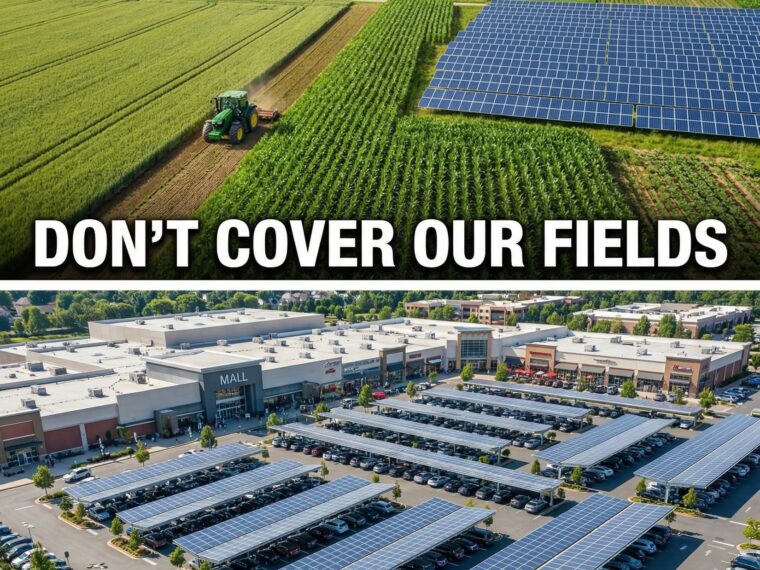
As the world pushes toward cleaner energy, solar power has become one of the fastest-growing solutions. Rows of panels stretching across the landscape are now a common sight—often replacing open land, and sometimes even productive farmland.
At first glance, it seems like progress. But it raises an important question:
Are we using our land in the smartest way possible?
🌱 The Value of Farmland
Farmland is more than just open space—it’s one of our most essential resources.
It provides:
- Food for growing populations
- Livelihoods for farmers
- Ecosystems that support biodiversity
Once farmland is covered with infrastructure, especially long-term installations, it can be difficult to restore it to its original productivity.
In a world already facing challenges around food security, every piece of fertile land matters.
⚡ The Rise of Solar Energy
Solar energy is critical for reducing dependence on fossil fuels and lowering carbon emissions. Large-scale solar farms can generate significant amounts of electricity and help countries move toward renewable energy goals.
But traditional solar farms require large, flat, open areas—which often overlap with agricultural land.
This creates a growing tension between two essential needs:
- Producing clean energy
- Producing food
🏙️ The Untapped Potential of Urban Spaces
Here’s where the conversation shifts.
Not all solar panels need to be placed on farmland. In fact, urban and built environments offer massive unused potential:
🚗 Parking Lots
- Large, open, and already developed
- Perfect for solar canopies
- Provide shade for vehicles while generating electricity
🏢 Rooftops
- Homes, offices, warehouses, and factories
- No additional land use required
- Reduces energy loss by producing power close to where it’s used
🏭 Industrial & Unused Spaces
- Abandoned lots
- Highways and infrastructure corridors
- Non-arable land
These areas allow energy production without competing with agriculture.
🌾 A Smarter Alternative: Combining Both
The solution may not be choosing between farmland and solar—but rethinking how they work together.
Agrivoltaics (Dual Land Use)
This approach combines agriculture and solar panels on the same land.
Benefits include:
- Crops growing under or between solar panels
- Reduced water evaporation due to shade
- Protection from extreme heat
- Additional income for farmers through energy production
In some cases, certain crops even perform better under partial shade.
⚖️ Balancing Food and Energy Needs
The challenge isn’t solar energy itself—it’s where and how we deploy it.
Covering fertile farmland with panels might be convenient, but it’s not always the most efficient or sustainable long-term solution.
A balanced strategy could include:
- Prioritizing rooftops and urban infrastructure
- Using non-arable or degraded land for large solar farms
- Supporting dual-use systems like agrivoltaics
🌍 Thinking Beyond “Either/Or”
Too often, we frame decisions as a choice:
- Food or energy
- Farms or solar
But the future depends on smarter integration.
By using space wisely, we can:
- Protect agricultural land
- Expand renewable energy
- Support both environmental and economic sustainability
🌟 Final Thoughts
Solar energy is a powerful tool for a cleaner future—but like any tool, its impact depends on how we use it.
Instead of covering the land that feeds us, we can look upward, outward, and toward innovation:
- Rooftops
- Parking lots
- Shared land solutions
Because the best solutions don’t force us to choose—they help us do more with what we already have.
So what do you think—fields or parking lots? Or a mix of both? 👇