
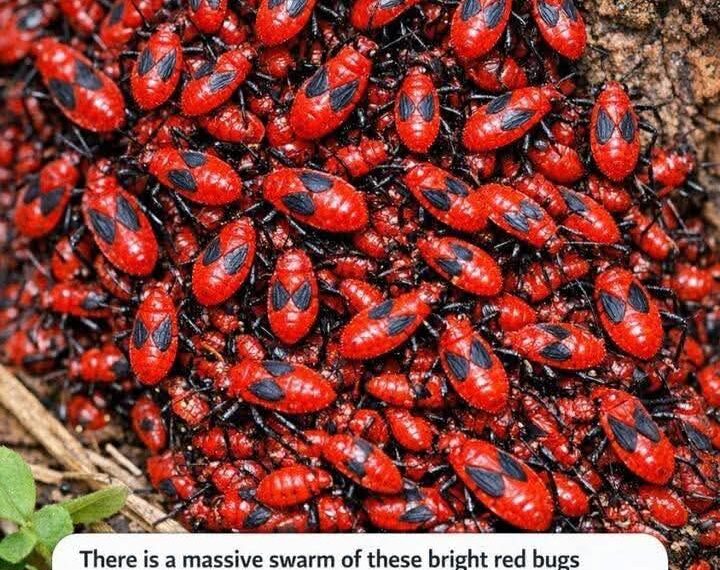
If you’ve ever walked into your garden and found a dense cluster of bright red insects piling on top of each other at the base of a tree, it can be both fascinating and a little alarming. The insects in your image strongly resemble firebugs, scientifically known as Pyrrhocoris apterus. Despite their dramatic appearance and behavior, these bugs are usually harmless and play a specific role in the ecosystem.
🔴 What Are These Red Bugs?
Firebugs are small, flat insects with striking red bodies and symmetrical black markings. They are commonly found in Europe, North Africa, and parts of Asia. Their bold coloration acts as a warning signal to predators that they are not good to eat.
They are often confused with other red-and-black insects, but their distinctive pattern and tendency to gather in large groups make them easy to identify.
🌳 Why Are They Gathering in Large Numbers?
The behavior you’re seeing—hundreds or even thousands of bugs clustering together—is completely normal for firebugs. There are several reasons behind this:
1. Warmth and Protection
Firebugs are attracted to warm, sunny spots. The base of a tree provides shelter and retains heat, making it an ideal gathering place.
2. Social Behavior
Unlike many insects, firebugs are social. They often cluster together for protection against predators and environmental stress.
3. Breeding Season
Large swarms are especially common during mating periods. You may notice pairs joined together, which is part of their reproduction process.
4. Food Source Nearby
Firebugs feed mainly on seeds, especially from linden (lime) trees and mallow plants. If your tree or nearby weeds produce suitable seeds, it becomes a feeding hotspot.
Are They Harmful to Your Garden?
Here’s the good news: firebugs are generally not harmful.
- They do not bite or sting humans
- They rarely damage healthy plants
- They mostly feed on fallen seeds and decaying plant matter
In fact, they can even contribute slightly to the natural cleanup process in your garden.
⚠️ When Do They Become a Problem?
While harmless in small numbers, their large swarms can be a nuisance:
TO CONTINUE READING THE ARTICLE PLEASE SEE PAGE 2